Doctors
Therapy fits alongside the care your doctor provides. They can refer, order sleep studies and prescribe as needed.
The Basics
Exercise therapy for the upper airway, mouth and face.
Myofunctional therapy is a tailored program of exercises and habit changes that retrains the muscles of the mouth, tongue, lips and face. It also focuses on breathwork and posture. Ashley Babb works one-on-one with adults and children 4 and up, and coordinates care with the other providers you see.
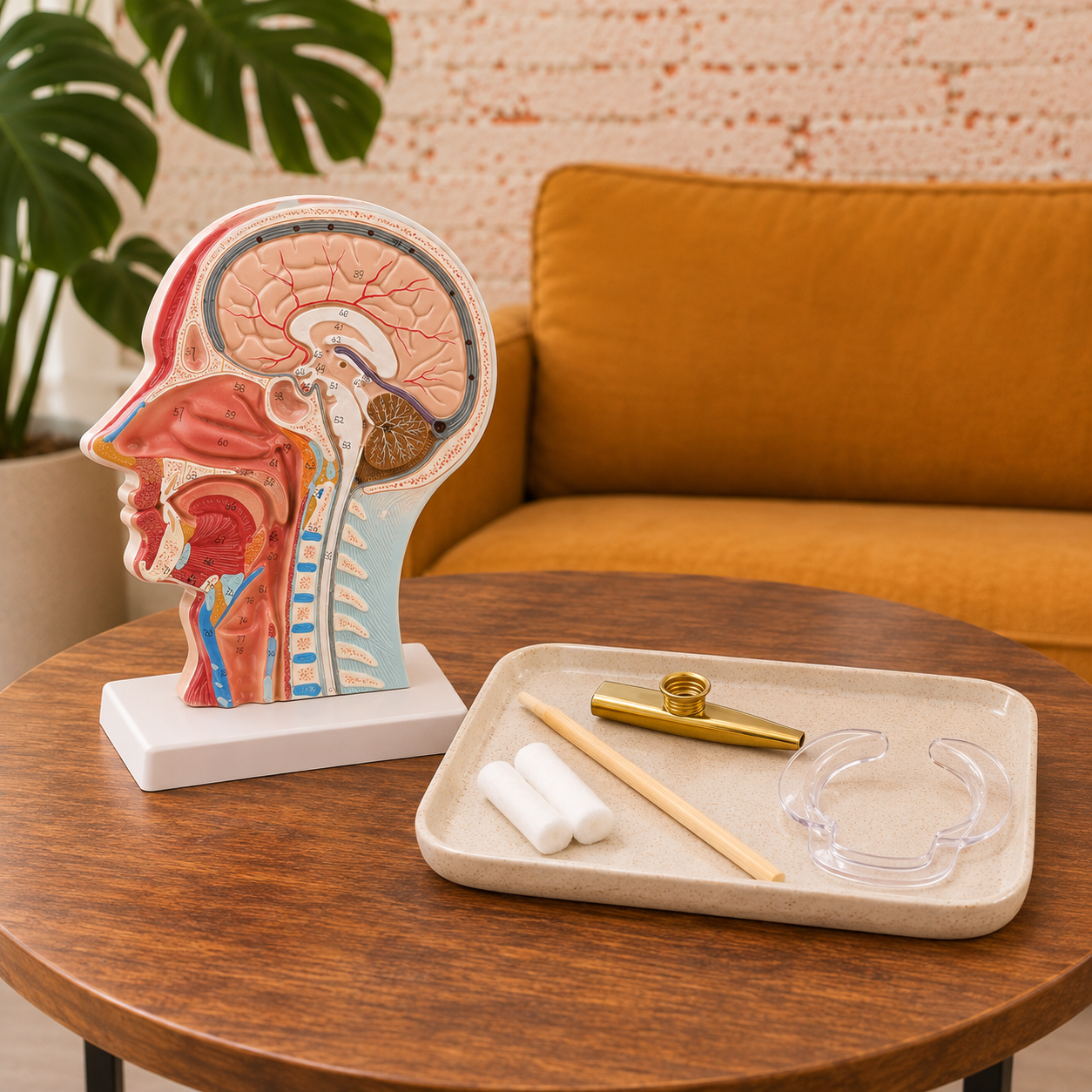
The goals are simple: breathing through the nose, lips gently sealed at rest, the tongue resting in a lightly suctioned state on the roof of the mouth, and a proper swallow pattern in the oral preparatory phase. When the muscles of the mouth and face are not working this way, it's called an orofacial myofunctional disorder (OMD). Therapy retrains those patterns, one small habit at a time.
Your program may also have secondary goals that are specific to you: the symptoms and concerns that brought you in, posture and breathing habits, and other health improvements we work toward alongside the main four.
Restless sleep, waking up tired, or struggling with snoring and sleep apnea.
SleepSnoring may improve by focusing on how the tongue and throat muscles work during sleep.
SnoringBreathing through the mouth, day or night, and chronic nasal congestion, allergies and cold-type illness.
Mouth BreathingMyo therapy before and after a tongue-tie release is imperative to effectiveness and proper healing.
Tongue-TieJaw tension, clenching and grinding are often tied to tongue posture and breathing.
Jaw Clenching & GrindingThumb sucking, tongue thrust, chewing and swallowing.
Kids & FamiliesMuscle habits like a low tongue or tongue thrust can play a part in teeth shifting after braces or aligners.
Bedwetting that continues past the usual age, and needing to urinate often during the night, can be connected to how breathing affects sleep cycles.
TMD, jaw pain or tension, and how the jaws grow and develop, supported by healthy tongue and lip habits.
Thumb sucking, pacifier use, nail biting and cheek biting that can be hard to let go of.
Thumb Sucking & Oral Habits
Ashley Babb is an Orofacial Myofunctional Therapist and the owner of Ithaca Myofunctional Therapy. An Ithaca native with a background in dental hygiene, she began her airway journey in 2019 and went on to train with the Academy of Orofacial Myofunctional Therapy (AOMT). She has since studied with Airway Circle, Buteyko Clinic and more, and teaches on faculty with MyoMentor.
Small daily habits, practiced consistently, add up.
60 to 90 minutes in person at our Ithaca office. We look at your history, symptoms, structure and function to get a whole-picture view of what's going on with your breathing, sleep and oral muscle habits.
Sessions every 1 to 3 weeks, virtually or in person, to learn exercises tailored to your specific needs. Exercises are simple (and fun!) and progress through your program.
About 10 to 20 minutes a day: working on tone and coordination, ultimately building new habits around breathing and oral function patterns that become automatic.
Therapy fits alongside the care your doctor provides. They can refer, order sleep studies and prescribe as needed.
Your ENT looks after the nose, sinuses, tonsils and adenoids; therapy works on the muscles alongside that care.
Your dentist takes care of your oral health and may also bring an airway-aware approach to care.
Myo therapy supports orthodontic treatment. When the muscles are working properly, the tongue helps shape the upper jaw and the lips and cheeks help hold the teeth in place, a natural retainer if you will. When muscle patterns aren't addressed, teeth can shift after braces come off, which is called orthodontic relapse.
These specialists address the whole or other parts of the body (cognitive, muscular or structural) beyond traditional medicine and the orofacial complex.
Chiropractors | Physical Therapists | Osteopaths | Occupational Therapists | Craniosacral Therapists | Massage Therapists
Speech-language pathologists work on speech, language and feeding. Myo therapy can support their work, especially when tongue posture, a tongue thrust or a tongue-tie is present. We work particularly well together when progress stalls and the intervention of the other helps get over that hurdle.
Providers can learn more on our For Providers page.
You can schedule on your own, or your provider can fill out our digital referral form. A referral is not necessary.
Airway, sleep and myofunctional health are only starting to be taught in dental, hygiene and speech programs. It takes time for new science to reach standard training, and longer for it to reach everyday practice, so your providers may not have had the chance to learn about it yet.
Some of the reasons these concerns are so common are part of modern life: softer, processed foods that give the jaw less work to do and encourage underdevelopment, allergens and pollutants that make nasal breathing harder, and the habit of treating common problems like crowded teeth or poor sleep as "normal." Common does not mean normal, or healthy.
Your assessment takes 60 to 90 minutes in our Ithaca office. Ashley reviews your health history, looks at how your mouth, tongue and face muscles are working, and takes measurements to build your plan.
What to send us:
The Pre-Assessment Guide walks you through what to notice before your appointment.
We see the difference better breathing and sleep can make with our patients every day. With commitment to the program, results can be profound, and sometimes preventative and life-changing. How much it helps depends on the person, their goals and how consistently they practice. It can also depend on existing skeletal structure, active collaborative care and other factors like weight, health conditions and access to care.
Research on myofunctional therapy is still growing, and studies, especially on sleep, show helpful results.
See the studies in our research library.
We are a fee-for-service practice and do not submit to insurance and are unable to provide coding for insurance submission.
It depends on your needs, your program and your commitment to the process. Your sessions are built around your goals and your starting point, so there is no set number of sessions. 4 to 10 months (6 to 15 sessions) is a rough average, highly dependent on age and program. Ashley will talk with you about her recommendations at your assessment.
Therapy sessions can be conducted in person or virtually, whichever is best and most convenient for you. Your first assessment is in person, at our Ithaca office.
No. We see adults and children 4 and up. Many of our patients are adults working on sleep, breathing, jaw tension or tongue-tie care.
Call us at (607) 602-2886
Hours: Monday–Thursday, 8:30 AM–4:00 PM, or appointments by request