
Frequently Asked Questions
What is Myofunctional Therapy?
Orofacial myofunctional therapy is a customized exercise program for the tongue and surrounding structures to facilitate proper oral rest posture, increase nasal breathing, encourage palate development, and promote restful sleep.
What problems does Myofunctional Therapy help with?
Therapy is implemented to correct orofacial myofunctional disorders (OMDs). These disorders can result in snoring and sleep apnea, chronic fatigue, sinus congestion, grinding and TMJ pain, malaligned teeth, orthodontic relapse, tongue thrusting, tooth decay, swallowing and chewing difficulties, poor facial tone, neck and shoulder tension, hunched posture, headaches and more.
Why is mouth breathing an issue?
Mouth breathing dries out the oral environment, encouraging tooth decay and dehydrated/inflamed tissue. Breaths taken in through the mouth are not filtered through our nasal passages, which makes us more susceptible to allergens, germs and particles in the air. Chronic mouth breathers as children may experience underdevelopment of the mouth, facial structures and airway, leading to further dysfunction.
Why is breathing through the nose ideal?
Our nasal passages filter out debris, warm and moisten the air we're taking in, and create nitric oxide - an important gas that improves oxygen circulation in the body. Breaths through the nose are slower, which can reduce stress and anxiety, lower blood pressure, improve heart health, increase energy and concentration, and more.
Also, your tongue should be up in the roof of the mouth, which is only possible while you are breathing through your nose!
What is proper "oral rest posture"?
At rest, both during sleep and while awake, we should have our lips sealed - breathing through the nose, tongue lightly suctioned to the roof of the mouth, and have a slight space between the teeth called the "freeway space".
This may be difficult or impossible if the nasal passages are not clear, the tongue is undertoned, or it's lacking the range of motion to rest in this position naturally.
Why should the tongue rest in the roof of the mouth?
Our tongue should naturally rest in the palate to:
• keep it "up" and "forward" - out of the throat
• to stimulate the vagus nerve and it's "rest and digest" response
• encourage lip seal and nasal breathing
• encourage proper development and width to the jaw during growth - making room to properly accommodate the tongue, teeth and growing an adequate upper airway system
What is "sleep disordered breathing" (SDB)?
Sleep disordered breathing refers to a range of conditions affecting resistance to proper airflow while we sleep. One example is snoring. Snoring is the sound created by air passing through the collapsed, relaxed tissues in your airway. This noise signifies that the airway is restricted. When this restriction blocks the airway entirely, sleep apnea can occur, where there are moments you stop breathing. Obstructive sleep apnea is diagnosed through a sleep study that identifies how frequently these pauses happen throughout the night.
How do I know if I have a tongue tie?
A myofunctional therapist can assess you for tongue and lip ties, as well as their level of severity.
Tongue restrictions are not always obvious. A clear tongue tie may be noted in an infant when it interferes with proper feeding, but sometimes the attachment is not addressed because it lies further back (a "posterior tie" or "mid-tongue restriction"), causing improper function of the tongue.
Unless very severe, a tissue tie's effect on function and development cannot be assessed with a quick look. A functional assessment is necessary to determine if your range of motion is limited due to tissue restriction. A provider who is untrained in assessing tethered oral tissues cannot determine the level at which your potential ties are affecting you.
How does myo therapy complement orthodontic treatment?
Myofunctional therapy can be preventative or done in conjunction with orthodontic treatment. In proper function and health, the jaw may develop enough that ortho intervention is not necessary. When the orofacial muscles are working as they should, the tongue serves as a natural palate expander and the cheeks and lips serve as retainers. When the jaw grows to the appropriate size, the teeth should erupt in alignment and the muscles should serve to keep them in place.
When dysfunction is not addressed, orthodontic treatment may be recommended to correct resulting malalignments. This intervention may only be temporary if the root cause is not correcte. Soft tissue (muscles + fascia) can work against hard tissue (teeth + bone)! This is why retainers must be worn for life, and without them the teeth can shift or revert, called "orthodontic relapse".
How does dysfunction affect TMJ, grinding and clenching at night?
When the upper airway space is being blocked or partially blocked by the tongue, your body's response is to activate muscles that pull the tongue out of the throat. This can result in tension when the muscles contract (clenching), shifting of the lower jaw in attempt to pull the tongue forward (grinding, aka bruxism), and TMJ issues when the jaw, joint and soft tissues are negatively impacted by this frequent muscle activation. This can lead to tension, pain, impairment, headaches and migraines. It can all take a toll on the teeth, causing wear, fractures and trauma.
Why do attention and behavioral concerns warrant a myofunctional assessment?
The list of characteristics associated with ADHD and other attention or behavioral disorders directly corresponds to that of poor sleep quality. We advocate that sleep and myofunctional health be assessed when any of these issues are diagnosed or being discussed as possibilities.
We firmly believe that to be well, we need to sleep well and breathe well. It is important to investigate potential root causes, especially before other interventions are implemented, such as medications.
Why haven't these issues been identified by my doctor(s) or dentist?
Airway, sleep and myofunctional health are just starting to be taught in dental, hygiene and speech curriculums. It takes a long time for science to be substantiated, longer for it to be incorporated into standard education, and even longer to be implemented in real life practice. It's very likely your providers are not aware, misinformed or untrained to use the screening tools that can help detect, prevent and treat orofacial myofunctional disorders.
Why are these issues so prevalent?
There are many things working against us in our modern world:
• The level of pollutants and allergens in our environment impact breathing and inflammation.
• Processed foods do not "exercise" the jaw like raw foods do, leading to underdevelopments of the jaw and muscles.
• Modern children's devices - like bottles, pacifiers, and sippy cups - encourage improper use the orofacial muscles that encourage dysfunction.
• Higher occurrence of tissue ties. Tongue ties impact the tongue's ability to grow a larger jaw and airway system, and to function properly when it comes to it's resting position, eating, swallowing, etc. Lip ties prop the lips in a way that encourages mouth breathing instead of nasal breathing. Scientists think that the addition of folic acid to our fortified grains for the past several years is encouraging these tissues to be much tighter.
• Unawareness. When professionals and the public are unacquainted with airway health, and we confuse common issues as "normal" (like the need for braces, pulling teeth due to lack of space, poor sleep, etc.), these concerns go unaddressed and undiagnosed.
• The lack of training and screening by professionals that are see patients early-on and routinely; namely pediatricians, dentists, and orthodontists.
• Prevention, early intervention and holistic care are on the rise, but western medicine and our general outlook on health care as a society still leans heavily on treating issues after they exist or worsen.
• Avoidance: many people don't seek care for their concerns; due to finances, lack of access, or disinterest in the commonly-known solutions, like braces or CPAPs.
• Professionals are not always staying informed and bridging the gaps. We need to educate and collaborate! Providers need to stay up to date on the happenings in our respective fields with continuing education, in order to provide the best care for our patients. We also need to recognize when it's time to connect with and refer to alternate providers in our patient's best interest.
How do I find the office?
Check out the directions below! 👇
DIRECTIONS
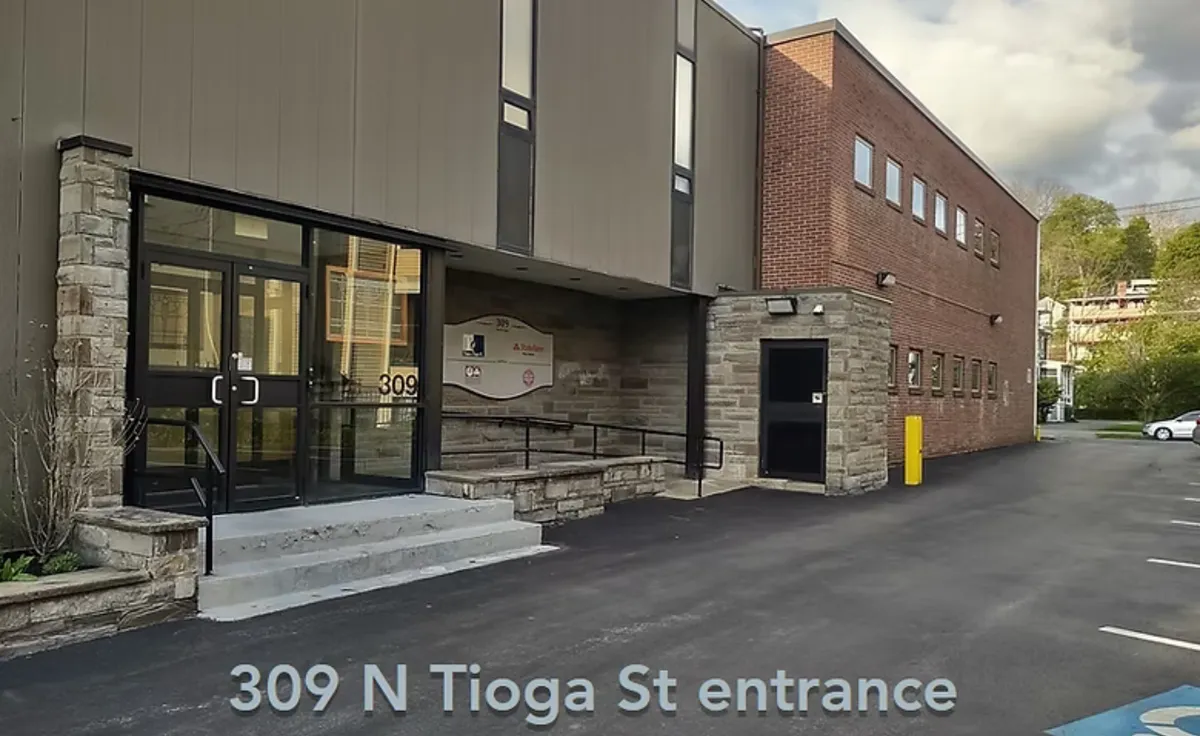
Ithaca Myofunctional Therapy's address is 310 N Aurora St,
*but the entrance to the office is through 309 N Tioga St (see photo below).
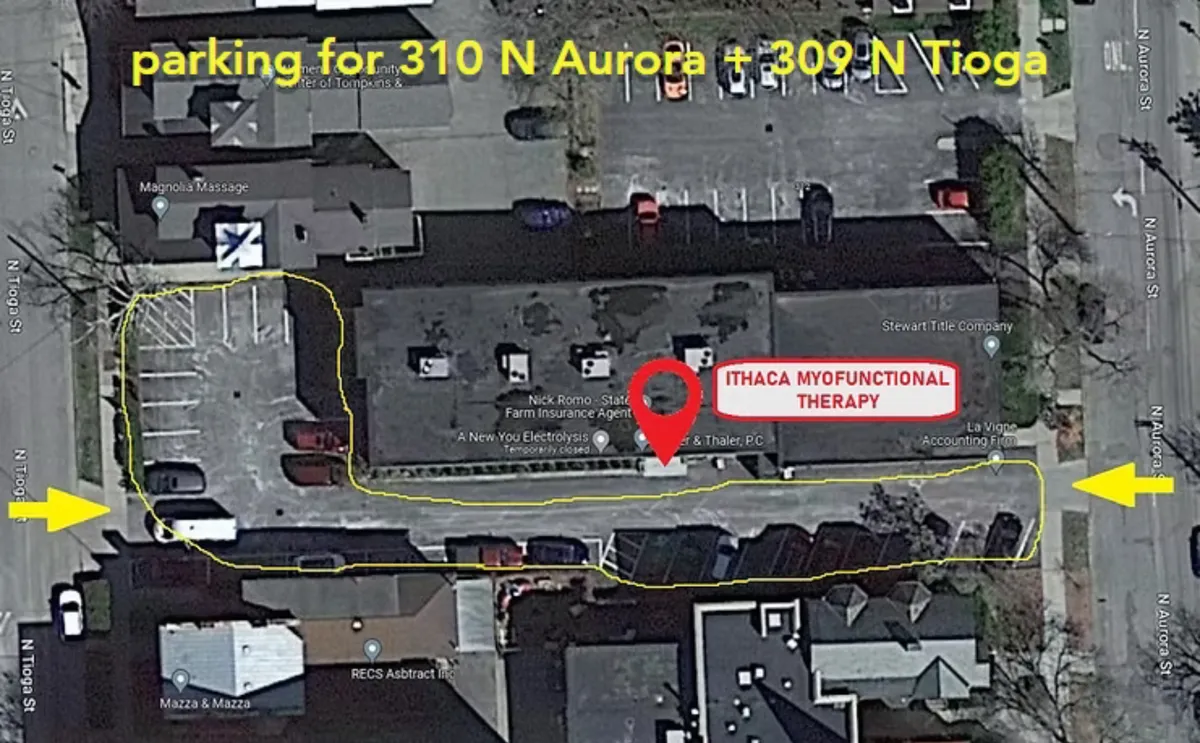
These two addresses share the same building and parking lot (second photo below);
the parking lot can be accessed by either street.
Parking is free with the use of a pass on your dashboard that you can print, or passes are available just inside the entrance in the lobby.
When you enter the building you can take the stairs to the second floor, then when you reach the top come in the left door labeled "310", Ithaca Myofunctional Therapy is down that hall. If you come up the elevator you will walk straight out and go through the door on your left, then through the "310" door and down the hall to Ithaca Myofunctional Therapy.
There are signs throughout to send you in the right direction.
DIRECTIONS
Ithaca Myofunctional Therapy's address is 310 N Aurora St, but the entrance to the office is through 309 N Tioga St (see photo below). These two addresses share the same building and parking lot (second photo below); the parking lot can be accessed by either street.
Parking is free with the use of a pass on your dashboard that you can print, or passes are available just inside the entrance in the lobby.
When you enter the building you can take the stairs to the second floor, then when you reach the top come in the left door labeled "310", Ithaca Myofunctional Therapy is down that hall. If you come up the elevator you will walk straight out and go through the door on your left, then through the "310" door and down the hall to Ithaca Myofunctional Therapy.
There are signs throughout to send you in the right direction.




Copyright 2026. Ithaca Myofunctional Therapy, LLC. All Rights Reserved.
(607) 288-2865 | [email protected]